
currency exchange and exchange rates concept with online converter
Ever wondered how travelers and businesses know the exact value of money in different currencies? Currency converters are digital tools that quickly change money values. They connect global economies with amazing accuracy.
Try our free currency converter to compare live exchange rates instantly, including USD to EUR, GBP, CAD, and more.
If you’re new to currency exchange, read our complete beginner’s guide to exchange rates.
A currency converter is an online tool that shows real-time exchange rates between currencies. Sites like trusted currency data providers give instant results, helping people and businesses understand money values worldwide. These tools use the huge global forex market, which deals with $7.5 trillion daily.
The secret of an exchange rate calculator is its access to live financial data. It connects to global markets, giving instant conversions that show current economic conditions. This helps users make smart financial choices.
Currency Converter
Key Takeaways
- Currency converters provide instant exchange rate calculations
- Real-time forex market data drives conversion accuracy
- Digital tools support global financial transactions
- Conversion rates change continuously based on market conditions
- Platforms like trusted currency data providers offer complete currency conversion services
Understanding Currency Exchange Rates and Their Role in Global Finance
“Several global factors explain why exchange rates change every day, including interest rates, inflation, and market demand.”
Global currency rates are key in today’s world. They show how much one country’s money is worth compared to another. This is how money moves across borders.

Related resources:
- How Inflation and Interest Rates Affect Currency Values
- Why Currency Converters Show Different Rates
- Use our free currency converter to compare live exchange rates
The way we convert money between countries is complex. It affects everything from travel to big business deals. Exchange rates change based on a country’s economy, politics, and market.
The Fundamental Purpose of Exchange Rates
Exchange rates do a lot in the global economy:
- They help with international trade
- They make it easier to invest in other countries
- They show how well a country’s economy is doing
- They help figure out how much things cost in different places
How Exchange Rates Impact International Trade and Travel
Exchange rates matter a lot in real life. For travelers and businesses, they affect how much you can spend and what you can do.
| Economic Context | Exchange Rate Impact |
|---|---|
| International Travel | Determines spending power abroad |
| Import/Export Business | Affects product pricing and competitiveness |
| Foreign Investments | Influences possible returns and risks |
Knowing about these things helps people and companies make smart money choices in today’s world.
What Is a Currency Converter and How Does It Calculate Rates?
Currency exchange tools have changed how we deal with money online. They make it easy and fast to handle international money deals.
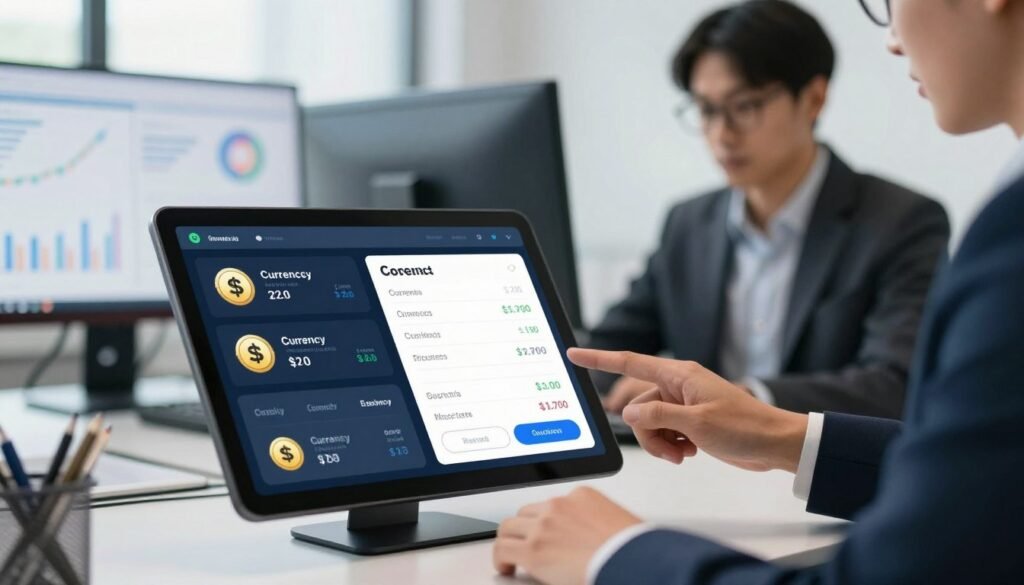
These tools work in a simple way. They do three main things to give you the right exchange:
- Get the latest forex rates from around the world
- Find out which two currencies you want to exchange
- Calculate how much money you’ll get by multiplying your amount by the rate
For example, if you want to change $100 USD to euros and the rate is 0.92, the tool will quickly show you 92 euros.
| Currency Converter Feature | Description |
|---|---|
| Input Methods | Full currency names, 3-letter ISO codes, country names |
| Data Sources | Real-time global forex markets |
| Calculation Speed | Instantaneous mathematical computation |
Platforms like OANDA have huge databases of currency tools. They offer conversions for thousands of currency pairs. They update rates all the time, so you always get the latest rates.
The beauty of these tools isn’t in the math. It’s in how they quickly and accurately use global financial data.
Currency Pairs and Base Quote Relationships
Knowing about currency pairs is key when using a foreign exchange calculator. Currencies are always traded in pairs. This means you buy one currency while selling another. This idea is at the heart of international money exchanges and global financial deals.
A currency pair has two currencies: a base and a quote. The base currency is the first one listed. It’s the currency you want to convert. The quote currency is the second one. It shows how much of that currency you can get in exchange.
Major Currency Pairs and Their Liquidity
Major currency pairs are the most traded in the global market. They usually involve the US dollar and other big global currencies.
- EUR/USD (Euro/US Dollar)
- USD/JPY (US Dollar/Japanese Yen)
- GBP/USD (British Pound/US Dollar)
- USD/CHF (US Dollar/Swiss Franc)
These major pairs are the most liquid. They can be quickly converted with low costs. Traders and travelers like them because they offer stable and competitive exchange rates.
Cross Rates and Minor Currency Pairs
Cross rates, or minor currency pairs, don’t include the US dollar. Examples are EUR/GBP or AUD/CAD. These pairs have wider spreads in a foreign exchange calculator. This means less favorable conversion rates because of lower trading volumes.
When using this currency converter, knowing these pair dynamics helps you make better choices for international money exchanges.
Direct and Indirect Quote Calculation Methods
Real-time currency conversion is about two main ways to show exchange rates: direct and indirect quotes. These methods help people understand currency values well.
A direct quote shows how much of your currency you need for one unit of another currency. For U.S. investors, it means showing foreign currencies in U.S. dollars. Here are some examples:
- USD/CHF exchange rate of 0.91 means you’ll need $1.10 to buy 1 Swiss franc
- USD/CAD rate of 1.45 indicates approximately $0.69 buys 1 Canadian dollar
Indirect quotes show how much foreign currency you need for one unit of your currency. This method is often used by traders and big companies for currency conversions.
Knowing both quote methods gives a full view of currency relationships. Most currency converters show rates in both ways. This helps users see exchange information from different views.
The underlying exchange rate remains constant—only the perspective changes.
Understanding these methods shows that they just show the same monetary relationship in different ways. This makes international money dealings clearer and easier to get into.
Real-Time Data Sources Behind Currency Conversion Tools
Currency converters use complex networks of financial data to give accurate exchange rates. Knowing how these tools work helps users make smart financial choices.
The global foreign exchange market connects financial institutions, banks, and electronic trading platforms. These tools get data from many real-time sources to ensure accurate exchange rates.
How Major Platforms Compile Exchange Rate Data
Many currency converters rely on institutional forex data sources used by banks and financial markets worldwide.
- Getting real-time forex market data
- Combining rates from various financial institutions
- Keeping big historical databases
- Keeping rate info up to date
Cash vs. Non-Cash Exchange Rates
It’s important to know the difference between cash and non-cash exchange rates. Each has its own special considerations:
| Rate Type | Characteristics | Typical Usage |
|---|---|---|
| Cash Rates | Include extra handling charges | Physical currency exchange |
| Non-Cash Rates | Have lower transaction costs | Electronic transfers, checks |
For travelers, the exchange rate accuracy can change a lot depending on the transaction method. An online currency converter data source usually shows mid-market rates. These are better than rates at airport exchange counters.
Choosing a trusted currency conversion platform means you get the latest and most accurate exchange rate info for your needs.
Factors That Influence Currency Exchange Rate Calculations
Understanding exchange rates means diving into the complex world of currency values. Many factors work together to cause changes in global currency markets.
Economic indicators are key in shaping currency values. Countries with strong economies draw more foreign investment. This affects exchange rates.
- Interest Rates: Higher rates draw international investors seeking better returns
- Inflation Levels: Lower inflation often signals currency strength
- GDP Growth: Robust economic expansion attracts foreign capital
- Employment Figures: Strong job markets indicate economic health
Market dynamics are also vital in currency value determinants. Institutional trades, speculative activities, and central bank actions cause big rate changes.
| Factor Category | Primary Influence |
|---|---|
| Economic Indicators | Investment Attractiveness |
| Market Dynamics | Trading Volume & Speculation |
| Geopolitical Factors | Political Stability |
Geopolitical events can quickly change exchange rates. Political stability, government policies, and international relations cause big changes. A single diplomatic issue or trade deal can lead to quick market reactions.
Currency markets reflect the complex balance between economic performance, market psychology, and global events.
Investors and travelers need to understand that exchange rates are a dynamic system. They constantly respond to many factors at once.
Common Mistakes When Using Currency Converters for International Transactions
Dealing with currency conversion can be tricky. “Many people lose money due to common currency conversion mistakes that are easy to avoid with the right information. ”Many pitfalls can cost a lot of money. It’s important to know about currency conversion mistakes and exchange rate fees to make smart choices.
Travelers and businesses often face unexpected costs when exchanging money. The most common mistakes can quickly drain your budget if you’re not careful.
Hidden Fees and Markup Charges in Currency Conversion
Currency conversion has several financial traps:
- Airport exchange kiosks charge highest markup rates (5-15% above mid-market rates)
- Banks add 2-5% exchange rate fees to transactions
- Credit card foreign transaction fees range from 0-3%
Understanding the Spread Between Bid and Ask Rates
The difference between bid and ask rates is a hidden cost many overlook. When exchanging currency, you get the less favorable rate. This means losing money on each transaction.
To avoid these mistakes, consider these strategies:
- Compare rates from multiple sources
- Use credit cards with no foreign transaction fees
- Leverage online money transfer services like Wise for more transparent rates
- Avoid last-minute exchanges at airports
By understanding these exchange rate fees, travelers and businesses can save a lot. Making informed currency conversion choices is key.
Want to check a conversion right now? Try our free live currency converter.
Conclusion
Understanding currency converters and exchange rates is key in today’s world. These tools give quick insights into money values across the globe. They help people and businesses make smart money choices.
Knowing about exchange rates helps users deal with money from different countries. Whether you’re planning a trip or handling business deals, these tools are handy. They show how money values change due to the economy, market feelings, and world events.
To use these tools well, you need to know about currency pairs and watch out for extra fees. Even though they make dealing with money easier, it’s important to be aware of any extra costs. This can affect how much money you get in the end.
Disclaimer: This content is for informational purposes only and should not be considered financial advice. Always consult with a qualified financial professional before making significant monetary decisions involving international currency exchanges.
Quick FAQ
Do currency converters use the same rate as banks?
Usually no. Most online converters show a mid-market rate, while banks add a markup or fees.
Why do currency converter rates change so often?
Rates update constantly because the forex market moves 24/5 based on supply, demand, and economic news.
How can I get the best conversion rate?
Compare providers, avoid airport kiosks, and watch for hidden fees and spreads.
Comments are moderated to maintain quality and relevance.