comparison of official exchange rates and market exchange rates using online converters
Ever wondered why the currency exchange rate at your bank is different from what you see online, and why exchange rates change every day? Learning about foreign exchange rates can give you key insights into global finance.
If you’re new to currency exchange, read our complete beginner’s guide to exchange rates.
Exchange rates are more than just numbers. They show the complex mix of government policies and market forces. The difference between official and market rates can greatly affect international trade, travel, and economic plans.
This article makes the world of official vs market exchange rates clearer. It explains how different things affect how currencies are valued. Whether you’re a curious traveler, a business person, or just interested in global economics, you’ll learn a lot about currency values and trades.
👉 Check live exchange rates instantly using our free currency converter
Key Takeaways
- Exchange rates show the value of one currency compared to another
- Official and market rates can differ a lot
- Global economic factors always change currency values
- Knowing exchange rates is key for international deals
- Market forces play a big role in setting currency prices
Understanding Exchange Rates and Their Role in Global Finance
Currency exchange is key in international economic dealings. It shows how different national currencies work together in the world market. Knowing these rates is vital for businesses, travelers, and economists.
International currency exchange is complex. It involves the interactions of national economies, financial markets, and global trade networks. These rates change often due to many economic factors.
What Is an Exchange Rate?
To understand how these values are actually determined, it helps to know how currency exchange rates work. For instance, if 1 US dollar can get you 20 Mexican pesos, that’s the current exchange rate between these two currencies.
- Expressed using three-letter currency codes (USD, EUR, JPY)
- Can be quoted in two directional formats
- Influenced by economic performance and market conditions
The Importance of Currency Valuation in International Trade
Currency valuation is very important in global economic dealings. When a country’s currency gets stronger or weaker, it changes how trade works. It affects how competitive exports are and how much imports cost.
Exchange rates are the invisible threads connecting global economies, determining the relative purchasing power across national borders.
| Currency Pair | Exchange Rate | Trade Impact |
|---|---|---|
| USD/EUR | 0.92 | Affects US-European trade competitiveness |
| USD/JPY | 148.50 | Influences manufacturing and technology exports |
| USD/MXN | 17.25 | Impacts North American trade relationships |
👉 Use our free currency conversion tool to understand real market rates
Businesses that deal with international currency exchange must watch these rates closely. They need to plan pricing, investments, and finances well. The world of currency valuation is complex but very important for global economics.
Official vs Market Exchange Rates: What’s the Difference?
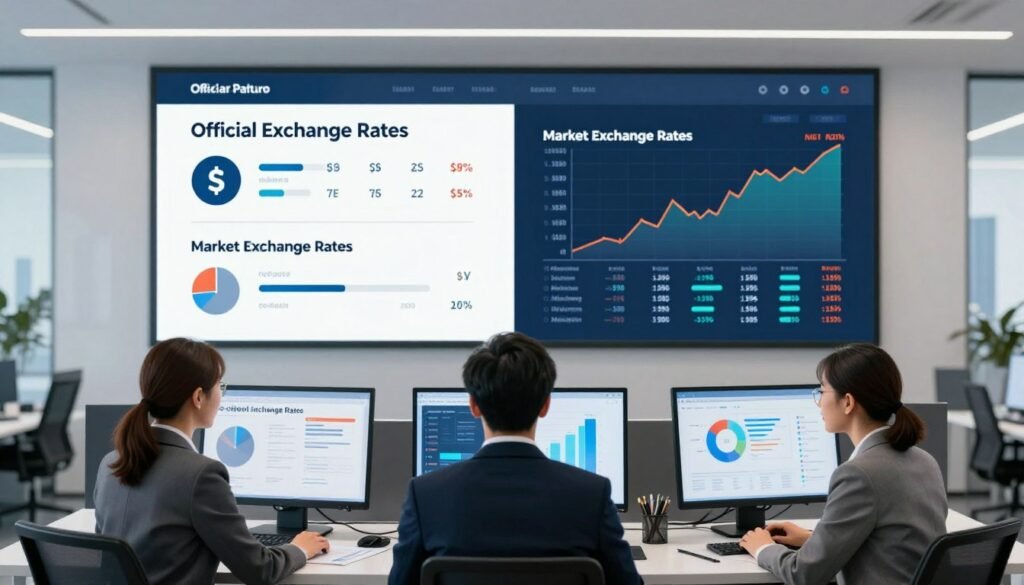
It’s important to know the difference between official and market exchange rates. These rates are key in international finance. They show how currencies are valued and traded worldwide.
Official exchange rates are set by a country’s government or central bank. They are the predetermined value of a currency that authorities want to keep. On the other hand, market exchange rates come from currency trading. They change based on supply and demand.
- Official rates: Controlled by government intervention
- Market rates: Determined by global financial markets
- Key difference: Flexibility and real-time valuation
The official vs market exchange rates can cause big financial problems. Some countries control their currency tightly, while others let the market decide. For example, the US dollar’s value changes all the time because of global trading.
“Currency is like water – it finds its natural level despite attempts to control it.” – Financial Market Analyst
Travelers and international businesses need to watch these rate differences closely. The rate from a central bank might not be the same as the one you get when exchanging money or doing international deals.
Knowing about official vs market exchange rates helps investors, travelers, and businesses make better financial choices. This is important in today’s global economy.
How Central Bank Exchange Rates Are Determined
Central bank exchange rates are key to global finance. They show how much a country’s money is worth compared to others. This is all thanks to complex rules set by central banks.
To get central bank exchange rates, we look at two main ways: fixed and floating rates. Each method helps control a country’s money value.
Government-Set Fixed Exchange Rates
Fixed rates mean central banks keep a certain value for their currency. They use a few main strategies:
- Pegging currency to another nation’s currency
- Maintaining narrow trading bands
- Actively managing foreign currency reserves
For example, the Hong Kong dollar is set to trade between 7.75 and 7.85 against the U.S. dollar. This needs constant help from the market.
The Role of Monetary Policy in Official Rates
Monetary policy affects exchange rates through big financial choices. Changing interest rates can really change how much a currency is worth:
| Policy Action | Currency Impact |
|---|---|
| Raising Interest Rates | Attracts foreign investment, strengthens currency |
| Lowering Interest Rates | Reduces investment appeal, weakens currency |
The Federal Reserve’s moves often change the dollar’s value right away. Central bank exchange rates are not random but are carefully managed tools.
Understanding Forex Market Rates and Floating Exchange Rates
The forex market is the biggest financial place in the world. It’s where currencies are traded all day, every day. The prices of these currencies change constantly, showing how the world’s economy is doing. Over $6 trillion is traded here every day.
Floating exchange rates let currencies change value based on how much people want them. These rates aren’t set by governments. Instead, they’re decided by the trading that happens all over the world.
- Global trading occurs 24 hours a day
- Rates change multiple times per minute
- Market participants include banks, corporations, and individual traders
Forex market rates have some key features:
| Feature | Description |
|---|---|
| Trading Volume | Over $6 trillion daily |
| Market Type | Decentralized electronic marketplace |
| Rate Determination | Supply and demand dynamics |
Currency values are not static but continuously evolving based on global economic conditions and market sentiment.
Floating exchange rates make international money dealings clear and flexible. Big currencies like the U.S. dollar, euro, and Japanese yen use this system. It lets the market decide their values, without needing government help all the time.
Key Factors That Create Exchange Rate Disparities
Exchange rate disparities come from the complex world of global finance. They arise from various economic factors that affect currency values in different countries.
Currency markets are like complex ecosystems. Different forces work together to set exchange rates. This mix of economic indicators, market expectations, and global financial dynamics offers both chances and hurdles for investors and traders.
Interest Rates and Economic Performance
Interest rates are key in shaping exchange rate differences. When countries face different economic situations, their currency values can change a lot. Important factors include:
- Central bank monetary policies
- Domestic economic growth rates
- Inflation expectations
- Unemployment levels
For example, if the United States Federal Reserve raises interest rates while the European Central Bank keeps them low, investors might prefer U.S. dollar investments. This can make the dollar more sought after, causing it to rise against the euro.
Supply and Demand in Foreign Exchange Markets
Exchange rate disparities mainly come from supply and demand basics. When more people want to buy a currency, its value goes up. But, when there’s more selling, the currency’s value goes down.
For instance, international trade and global investment flows lead to constant currency valuation pressures.
Investors and economists watch these trends closely. They aim to understand and forecast exchange rate changes in various financial markets.
Real-World Impact of Exchange Rate Differences
International currency exchange has a big impact on people and businesses. Travelers and companies deal with complex financial situations. Exchange rates can greatly affect how much you can buy and make economic choices.
Consumers face direct effects from international currency exchange in many ways:
- Traveling abroad and converting money
- Purchasing international products online
- Investing in foreign markets
- Receiving payments from international clients
For travelers, knowing exchange rates is key. Currency conversion isn’t as simple as online tools show.This is why it’s important to understand conversion really is before exchanging money. Banks and exchange services often charge extra, 3-7% more. So, a $200 exchange might give you €180-185, not the full market rate.
Businesses have bigger challenges with international currency exchange. Fluctuating rates can affect:
- Import costs
- Export competitiveness
- Profit margins
- Investment strategies
Multinational corporations use hedging to manage currency risks. When the U.S. dollar gets stronger, travel to the U.S. is cheaper. But, foreign tourists might find the U.S. pricier.
Smart international currency exchange means knowing the market and hidden fees.
Here are some tips for dealing with international currency exchange:
- Use credit cards with no foreign transaction fees
- Withdraw cash from local ATMs
- Check current market rates before traveling
Black Market Currency and Restricted Exchange Systems
Currency exchange can get tricky when official rates don’t match the market. Black market currency is a way to deal with strict financial rules. It offers a way for people to manage their money better.
Governments use strict currency controls to tackle economic issues. These rules can make a big gap between what’s officially allowed and what really happens in the market.
Divergence Between Official and Market Rates
When official rates don’t make sense, black market trading starts. This hidden economy lets people:
- Find better currency values
- Get around government rules
- Keep their money safe
👉 Convert USD, EUR, GBP, CAD, and more using our free currency converter
Economic Consequences of Currency Restrictions
Countries with big black market currency problems face big economic troubles. Here’s a look at some key numbers:
| Country | Official Rate | Black Market Rate | Difference (%) |
|---|---|---|---|
| Venezuela | 1:7 USD | 1:25 USD | 257% |
| Argentina | 1:10 USD | 1:18 USD | 80% |
These numbers show how black market currency reveals big economic problems. Trying to control exchange rates can lead to more uncertainty.
“Currency controls are like trying to hold water in your hands—the more you squeeze, the more it escapes.” – Economic Analyst
Understanding these issues helps both individuals and leaders see how official money rules affect real life.
Want to check a conversion right now? Try our free live currency converter.
Conclusion
Understanding foreign exchange rates can seem hard. But knowing the difference between official and market rates is key. This is important for anyone dealing with money across borders.
Whether you’re traveling or doing business globally, knowing how currency values change is vital. This knowledge helps you make better financial choices.
Foreign exchange rates are very important in the world economy. They affect everything from travel costs to international trade. The gap between official and market rates can change how much money is worth when you cross borders or do business abroad.
It’s important for both consumers and businesses to know about these differences. This knowledge helps them make the most of their money.
FAQ Section: Common Questions About Foreign Exchange Rates
Q: Why do exchange rates differ between banks and online sources?
A: Banks often add extra fees to the mid-market rate. This makes the exchange rate you get different.
Q: How frequently do exchange rates change?
A: Market rates can change many times a minute. Even small economic changes can affect currency values.
Q: What’s the most cost-effective way to exchange currency?
A: Using ATMs abroad or credit cards with no foreign transaction fees is usually the best option. It often gives you better exchange rates than traditional currency exchange services.
Disclaimer: This content is for informational purposes only and should not be considered financial advice. Always consult with qualified financial professionals before making currency exchange or international financial decisions.