Learn how to convert money from one currency to another using exchange rates, a simple formula, and real-world examples. See how fees and exchange rate spreads affect the final amount.
Converting money from one currency to another sounds complicated until you understand the basic calculation behind it.
Whether you’re preparing for an international trip, shopping from an overseas website, sending money abroad, or simply trying to understand what your dollars are worth in another country, currency conversion follows a fairly simple process.
The important part is knowing which exchange rate you’re using and whether additional fees or exchange-rate markups are included.
In this guide, we’ll walk through currency conversion step by step, explain the basic formula, and show why the amount you actually receive may be different from what you see on a currency converter.
What Does It Mean to Convert Currency?
Currency conversion means calculating how much money in one currency is worth in another currency.
For example, you might want to know how many euros you could receive for $500 USD.
Or perhaps you’re traveling to Japan and want to estimate how many Japanese yen $1,000 could buy.
The currencies have different values relative to one another, so you need an exchange rate to perform the calculation.
An exchange rate tells you how much one currency is worth in terms of another.
The Basic Currency Conversion Formula
The simplest currency conversion calculation is:
Amount in original currency × exchange rate = amount in new currency
For example, imagine the hypothetical exchange rate is:
1 USD = 0.86 EUR
If you wanted to convert $500:
$500 × 0.86 = €430
So $500 would theoretically equal approximately €430 at that exchange rate.
The word theoretically is important.
The amount you actually receive from a bank, currency exchange service, ATM, credit card company, or money-transfer provider could be different because of fees and exchange-rate markups.
Try a Currency Conversion
You can use the Voltcurrency converter to estimate a currency conversion without doing the calculation manually.
Currency Converter
Currency Converter
Enter the amount you want to convert, choose your starting currency and destination currency, and compare the result.
Remember that online currency calculations should generally be treated as estimates. The rate offered by your bank or financial provider may differ.
How to Convert Money Step by Step
Let’s break the process into four simple steps.
Step 1: Identify Your Two Currencies
First determine which currency you have and which currency you want.
For example:
From: U.S. dollars (USD)
To: British pounds (GBP)
Currency codes make it easier to identify currencies internationally.
Some common examples include:
- USD — U.S. Dollar
- EUR — Euro
- GBP — British Pound
- JPY — Japanese Yen
- CAD — Canadian Dollar
- AUD — Australian Dollar
- INR — Indian Rupee
- PHP — Philippine Peso
Once you know the currency pair, you can look up the exchange rate.
Step 2: Find the Exchange Rate
Suppose you want to convert USD to GBP.
For illustration purposes, imagine the exchange rate is:
1 USD = 0.75 GBP
That means every U.S. dollar would theoretically purchase 0.75 British pounds before considering fees or provider markups.
Exchange rates constantly move, so always check the current rate when making an actual transaction.
Step 3: Multiply Your Money by the Exchange Rate
Now use the currency conversion formula:
Money × Exchange Rate = Converted Amount
If you have $1,000:
1,000 × 0.75 = 750
Your estimated conversion would therefore be:
$1,000 USD ≈ £750 GBP
Again, this is an example rather than a current exchange-rate quote.
Step 4: Compare the Rate You’re Actually Being Offered
This is where currency conversion becomes more interesting.
The exchange rate you see online isn’t necessarily the exchange rate your bank gives you.
You may see one rate on a currency converter and another when you actually exchange your money.
Why?
One reason is something called the exchange rate spread.
Why Your Actual Currency Conversion May Be Different
Financial institutions and currency providers don’t necessarily exchange currencies at the exact mid-market exchange rate.
The mid-market rate is essentially the midpoint between the buying and selling prices of two currencies in the foreign exchange market.
Consumers may instead receive a rate containing a markup.
For example, imagine the mid-market rate indicates:
1 USD = 0.86 EUR
But a provider offers:
1 USD = 0.83 EUR
On a small transaction, the difference might not look dramatic.
But consider $5,000.
At 0.86:
$5,000 × 0.86 = €4,300
At 0.83:
$5,000 × 0.83 = €4,150
That’s a difference of €150 before considering any separate transaction fees.
This is why understanding the exchange rate can matter just as much as knowing the conversion formula.
Related Guide:
Currency Mid-Market Rate Explained
What Is an Exchange Rate Spread?
The difference between a market reference rate and the rate available to a customer can contribute to the overall cost of exchanging money.
This difference is often discussed as an exchange rate spread.
Some providers may also charge separate fees.
That means there can potentially be two costs to watch:
Exchange-rate markup + transaction/service fee
A provider advertising a low or even zero transfer fee isn’t automatically the least expensive option if its exchange rate is less favorable.
That’s why it’s useful to compare the final amount received, rather than looking only at the advertised fee.
Learn More:
Exchange Rate Spread Explained
Should You Multiply or Divide When Converting Currency?
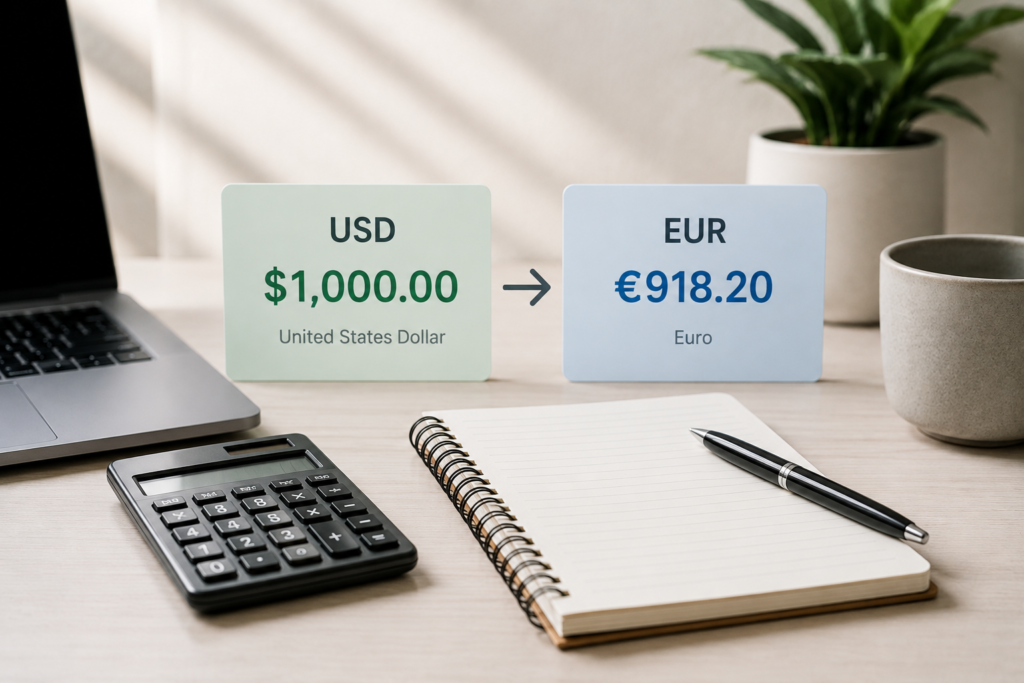
This is one of the most confusing parts of manual currency conversion.
The answer depends on how the exchange rate is quoted.
Suppose:
1 USD = 150 JPY
To convert $100 USD into yen:
100 × 150 = 15,000 JPY
But what if you have 15,000 JPY and want to calculate its approximate value in USD using that same quote?
You would reverse the calculation:
15,000 ÷ 150 = $100
A simple rule is:
Moving in the same direction as the quoted rate → multiply.
Moving backward through the quoted rate → divide.
If you’re unsure, a currency converter removes much of this confusion.
Example: Converting Money for International Travel
Suppose you’re planning an international vacation and have a $2,000 spending budget.
Before traveling, you want to estimate how much your money is worth in the destination currency.
You could:
- Check the current exchange rate.
- Convert your $2,000 using that rate.
- Check the rate offered by your bank or card.
- Look for foreign transaction or ATM fees.
- Compare the final expected cost.
This gives you a more realistic picture of your travel budget than simply looking at the headline exchange rate.
Exchange rates can therefore affect the actual cost of hotels, restaurants, transportation, attractions and shopping.
Example: Converting Money for an International Purchase
Currency conversion also matters when buying something online.
Imagine a product costs €250, but your account is denominated in U.S. dollars.
You need to know approximately how many dollars the €250 purchase represents.
However, your final card statement may depend on:
- The exchange rate used by the payment network
- When the transaction is processed
- Whether your card charges a foreign transaction fee
- Whether the merchant performs the conversion
This is why the amount estimated before purchasing and the final amount charged can occasionally differ.
How to Convert Money From One Currency to Another
These terms are related but slightly different.
Currency conversion usually refers to calculating the value of one currency in another.
Currency exchange refers to actually exchanging one currency for another.
You can therefore calculate a conversion without actually exchanging any money.
For example, you might use Voltcurrency to estimate what $500 USD is worth in euros while planning a trip.
The actual exchange happens later when a bank, ATM, card network or currency provider processes the transaction.
Why Currency Exchange Rates Change
Exchange rates aren’t permanently fixed for most major currencies.
Their values can change throughout the day as global currency markets react to economic and financial conditions.
Factors that can influence exchange rates include:
- Interest rates
- Inflation
- Central-bank decisions
- Economic growth
- Employment data
- International trade
- Political and economic uncertainty
- Investor demand for particular currencies
This is why a conversion you calculate today may produce a different result later.
A Simple Way to Compare Currency Conversions
When comparing currency providers, don’t focus exclusively on the exchange rate or fee.
Instead ask:
How much money will the recipient actually receive?
Suppose you’re converting $1,000 and comparing two services.
One service may charge a visible fee but offer a stronger exchange rate.
Another may advertise no transfer fee but use a wider exchange-rate markup.
Looking at the final amount received makes the comparison much easier.
Popular Currency Conversions
You can also explore individual currency conversion guides on Voltcurrency:
USD to PHP Exchange Rate Guide
USD to MYR Exchange Rate Guide
And use the Voltcurrency converter whenever you need a quick conversion estimate.
Frequently Asked Questions
How do I convert money into another currency?
Find the exchange rate between your starting and destination currencies and apply it to your amount. When the quote states how much destination currency equals one unit of your starting currency, you generally multiply your amount by that rate.
What is the formula for converting currency?
A basic formula is:
Original amount × exchange rate = converted amount
However, whether you multiply or divide depends on the direction in which the exchange rate is quoted.
Why does Google show a different exchange rate than my bank?
A market reference rate and a consumer exchange rate may differ. Banks and currency providers can incorporate exchange-rate markups and may also charge transaction or service fees.
Do exchange rates change every day?
Yes. Floating exchange rates can change frequently, including throughout a single trading day.
What is the mid-market exchange rate?
The mid-market rate represents the midpoint between the buy and sell prices for a currency pair in the foreign exchange market. Consumer providers may offer customers a different rate.
Is a currency converter exact?
A converter is useful for estimating currency values, but it doesn’t guarantee the exact amount you’ll receive in a real transaction. Your provider’s rate, fees and timing can affect the final amount.
Final Thoughts
Learning how to convert money from one currency to another is surprisingly simple once you understand the exchange rate.
The basic calculation may take only a few seconds.
But understanding what exchange rate you’re receiving is what can make the calculation truly useful.
Whenever you’re traveling, shopping internationally or sending money abroad, compare the market rate with the rate you’re actually being offered and consider any additional fees.
That way, you’re not simply converting currency—you’re understanding what the conversion may actually cost.
Voltcurrency provides currency conversion tools and educational information for general informational purposes only. Exchange rates can change frequently, and displayed or example rates should not be considered guaranteed transaction rates. Banks, card issuers, money-transfer providers and other financial institutions may use different rates and charge additional fees. Always verify the final exchange rate and costs with your financial provider before completing a transaction.