Learn what an exchange rate spread is, why banks and money transfer services use it, how it differs from the mid-market rate, and how to avoid paying unnecessary exchange costs.Exchange Rate Spread Explained: Why You Receive Less Money Than Expected
Whether you’re traveling abroad, sending money internationally, shopping from overseas retailers, or exchanging foreign currency at your local bank, you’ve probably noticed something surprising:
The exchange rate you receive is almost never the same as the one you see on Google.
Many people assume they’re simply paying a small transaction fee. In reality, the biggest hidden cost is often something called the exchange rate spread.
Understanding how exchange rate spreads work can help you save money on international transfers, avoid expensive currency exchanges, and make smarter financial decisions whenever you convert one currency into another.
Try Our Currency Converter
Use our free currency converter to compare exchange rates before exchanging money.
Currency Converter
What Is an Exchange Rate Spread?
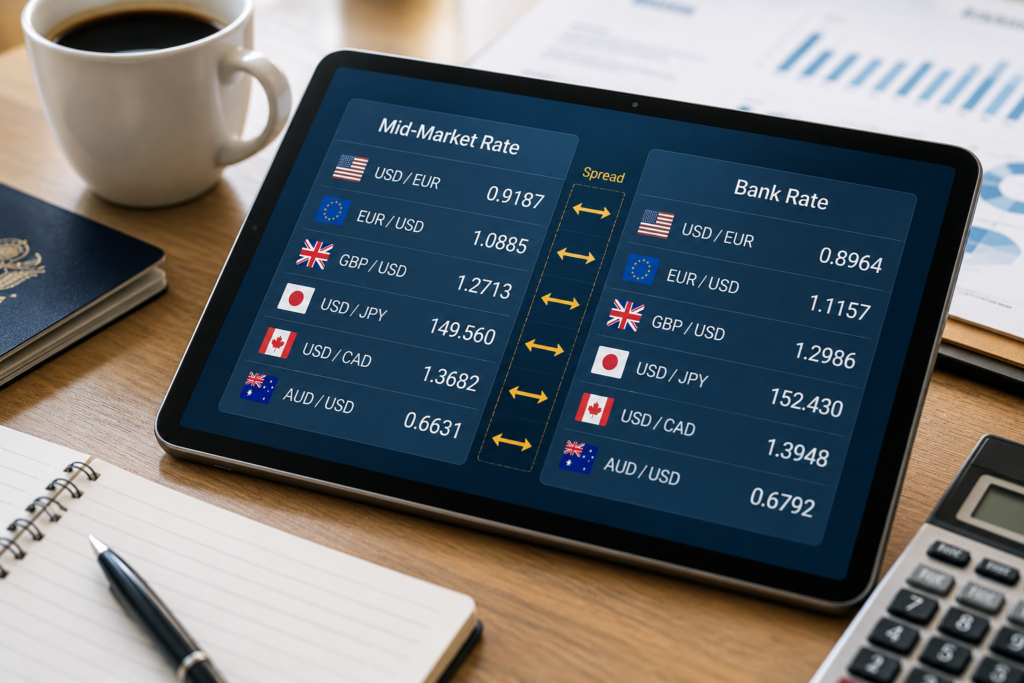
An exchange rate spread is the difference between the mid-market exchange rate (also called the interbank rate) and the exchange rate that a bank, airport exchange counter, credit card company, or money transfer service offers you.
Think of it as the company’s profit margin.
Instead of charging a large upfront fee, many financial institutions simply give you a slightly worse exchange rate.
Even a small difference can become expensive when converting hundreds or thousands of dollars.
Example
Suppose the actual mid-market exchange rate is:
1 USD = 0.92 EUR
A bank may instead offer:
1 USD = 0.89 EUR
The difference between 0.92 and 0.89 is the exchange rate spread.
Although it appears small, you’ll receive fewer euros for every dollar exchanged.
Why Do Banks Use Exchange Rate Spreads?
Banks and currency exchange providers don’t exchange money for free.
Instead of charging customers a clearly visible service fee, many institutions build their profit directly into the exchange rate they provide.
This approach allows them to advertise:
- Low fees
- No transfer fee
- Free currency exchange
While still earning money through the spread.
This is one reason why comparing exchange rates—not just fees—is so important.
What Is the Mid-Market Rate?
The mid-market rate is considered the fairest exchange rate available.
It sits halfway between the price banks buy currencies and the price they sell them to one another.
This rate is constantly changing as currencies trade around the world 24 hours a day during global market hours.
Unlike retail exchange rates, the mid-market rate generally does not include profit margins or hidden markups.
If you’d like to learn more about how it works, read our complete guide:
Currency Mid-Market Rate Explained
Mid-Market Rate vs Exchange Rate Spread
| Mid-Market Rate | Exchange Rate Offered to You |
|---|---|
| Actual market value | Includes a markup |
| Used by financial institutions | Used by consumers |
| No profit margin | Includes company profit |
| Changes continuously | Set by each provider |
| Benchmark rate | Retail exchange rate |
The larger the spread, the more money you lose during the exchange.
How Much Can an Exchange Rate Spread Cost?
Many people assume losing one or two cents per dollar isn’t significant.
Unfortunately, that difference grows quickly.
Example 1
You exchange $500 USD.
Mid-market rate:
1 USD = 0.92 EURYou would receive:
460 EURBank rate:
1 USD = 0.89 EURYou receive:
445 EURDifference:
15 EURWithout paying any obvious service fee, you’ve effectively lost the value of 15 euros simply because of the exchange rate spread.
Example 2
Now imagine exchanging $5,000.
That same difference becomes much larger, which is why travelers, businesses, and international investors often compare exchange rates before converting larger amounts.
Who Uses Exchange Rate Spreads?
Nearly every company involved in currency exchange uses some form of spread.
Examples include:
- Banks
- Airport currency exchange counters
- Online money transfer companies
- International payment processors
- Credit card companies
- Foreign exchange brokers
- Currency exchange kiosks
- Travel money services
The size of the spread varies from one provider to another, making comparison an important step before exchanging money.
Why Airport Currency Exchanges Are Usually More Expensive
Airport exchange counters are convenient, but convenience often comes at a price.
Because travelers typically need cash immediately, airport providers frequently offer exchange rates with larger spreads than banks or online services.
That means you receive less foreign currency for the same amount of money.
If possible, compare rates before traveling or consider withdrawing local currency from an ATM after arriving at your destination.
Hidden Costs Beyond the Exchange Rate
The exchange rate spread is only one possible cost.
Some providers may also charge:
- Fixed service fees
- International transfer fees
- ATM withdrawal fees
- Foreign transaction fees
- Wire transfer charges
- Currency conversion commissions
Understanding every fee involved helps you determine the true cost of exchanging money.
How to Calculate an Exchange Rate Spread
You don’t need to be a financial expert to estimate an exchange rate spread. With just two numbers—the mid-market rateand the rate offered by your provider—you can see how much you’re paying in hidden costs.
Formula
Exchange Rate Spread =
Mid-Market Rate − Offered Exchange Rate
Example
Mid-market rate:
1 USD = 0.9200 EURBank rate:
1 USD = 0.8900 EURSpread:
0.9200 − 0.8900 = 0.0300This means the provider keeps a margin of 0.03 EUR per U.S. dollar exchanged.
How to Compare Exchange Rates
Before exchanging money, compare more than just advertised fees.
Ask these questions:
- What is today’s mid-market exchange rate?
- What exchange rate is the provider offering?
- Are there any transfer fees?
- Is there a minimum fee?
- Are there ATM or foreign transaction fees?
- How much foreign currency will I actually receive?
The provider with the lowest fee isn’t always the least expensive overall.
Ways to Reduce Exchange Rate Costs
Fortunately, there are several ways to keep more of your money.
1. Compare Multiple Providers
Banks, online money transfer companies, and foreign exchange services all use different exchange rates.
Even a small improvement in the rate can save money.
2. Know the Mid-Market Rate
Checking the mid-market rate before making a transfer gives you a benchmark for comparison.
If the offered rate is significantly lower, you may want to shop around.
3. Avoid Airport Currency Exchanges
Airport exchange counters are convenient but often have some of the widest exchange rate spreads.
If possible, exchange only a small emergency amount before your trip.
4. Exchange Larger Amounts Less Frequently
If you’re paying a fixed transfer fee each time, combining several small exchanges into one larger transaction may reduce your overall costs.
Always compare rates before deciding.
5. Watch for Promotional Rates
Some providers occasionally offer reduced spreads or promotional exchange rates for new customers.
Reading the fine print can help you determine whether the promotion actually saves money.
Common Mistakes People Make
Many travelers and first-time international shoppers unknowingly pay more than necessary.
Avoid these common mistakes:
- Assuming all exchange rates are the same
- Looking only at transfer fees
- Ignoring the exchange rate itself
- Exchanging money at airports
- Waiting until the last minute
- Not comparing multiple providers
- Confusing the mid-market rate with the retail exchange rate
Exchange Rate Spread vs Foreign Transaction Fee
These two charges are often confused.
| Exchange Rate Spread | Foreign Transaction Fee |
|---|---|
| Hidden inside the exchange rate | Separate percentage fee |
| Reduces the amount of foreign currency received | Added after the purchase |
| Charged by exchange providers | Usually charged by credit card issuers |
| Can vary widely | Often 1%–3% of the transaction |
In many cases, you may pay both a foreign transaction fee and an unfavorable exchange rate.
Frequently Asked Questions
What is an exchange rate spread?
An exchange rate spread is the difference between the mid-market exchange rate and the exchange rate offered by a bank, money transfer company, or currency exchange provider. The spread represents the provider’s profit margin.
Is the exchange rate spread the same as a fee?
No. A fee is usually charged separately, while the exchange rate spread is built into the exchange rate itself. Because it’s less obvious, many people don’t realize they’re paying it.
Why is the mid-market rate better?
The mid-market rate reflects the actual market value of a currency pair without additional markups. It serves as a useful benchmark when comparing exchange rates from different providers.
Can I avoid paying an exchange rate spread?
Not completely. Nearly all providers include some spread. However, comparing providers and understanding how exchange rates work can help reduce your overall costs.
Do online money transfer services always offer better exchange rates?
Not necessarily. Some services provide rates that are closer to the mid-market rate, while others use wider spreads. Always compare the final amount you’ll receive.
Final Thoughts
Understanding exchange rate spreads is one of the easiest ways to become a smarter international traveler, online shopper, or investor.
The next time you exchange currency, don’t focus only on advertised fees. Compare the exchange rate itself and use the mid-market rate as your reference point.
Even a small difference in the exchange rate can save—or cost—you a significant amount of money over time.
By taking a few minutes to compare providers, you’ll have a better chance of receiving more value every time you convert currency.
Related Articles
Add these internal links to strengthen your topical authority:
- Currency Mid-Market Rate Explained
- How to Convert Currency Step by Step
- Convert Money Between Currencies Guide
- Simple Currency Exchange Formula
- Why Do Exchange Rates Fluctuate?
Schema FAQ Questions
- What is an exchange rate spread?
- How is an exchange rate spread calculated?
- Why is the mid-market rate important?
- Do banks always charge an exchange rate spread?
- How can I reduce currency exchange costs?
Disclaimer
Information on VoltCurrency is provided for educational purposes only and should not be considered financial, investment, tax, or legal advice. Exchange rates change continuously, and fees vary by provider. Always verify current rates and terms with your bank or currency exchange service before making financial decisions.