
If you have ever looked at an exchange rate such as EUR/USD 1.17 or USD/JPY 147.50, you may have wondered what those numbers actually mean.
Exchange rates are usually displayed as currency pairs. One currency is compared with another, and the number tells you how much of one currency is needed to buy a unit of the other.
Once you understand which currency comes first, which comes second, and how to read the number, exchange-rate quotes become much easier to understand.
In this guide, we’ll explain how exchange rates are quoted, what base and quote currencies mean, how to read currency pairs, and how buy and sell rates can affect the amount of money you receive.
What Is an Exchange Rate Quote?
An exchange rate quote shows the value of one currency compared with another.
Currencies are therefore normally shown in pairs.
For example:
EUR/USD = 1.17
The first currency is the base currency.
The second currency is the quote currency, sometimes called the counter currency.
In this example:
- EUR is the base currency.
- USD is the quote currency.
- 1.17 is the exchange rate.
The quote means:
1 euro = 1.17 U.S. dollars
The exact market rate changes over time, but the method for reading the quote remains the same.
Base Currency vs. Quote Currency
Understanding the base and quote currencies is one of the most important parts of reading an exchange rate.
Base Currency
The base currency is the first currency shown in the pair.
For example:
GBP/USD
GBP is the base currency.
The base currency is generally treated as one unit when interpreting the exchange-rate quote.
Quote Currency
The quote currency is the second currency.
Using the same example:
GBP/USD
USD is the quote currency.
The exchange rate tells you how many units of the quote currency correspond to one unit of the base currency.
Suppose:
GBP/USD = 1.35
This means:
£1 = $1.35
That’s the basic structure behind most currency-pair quotations.
Try a Currency Conversion
Want to see how one currency compares with another?
Use the VoltCurrency converter below to explore different currencies and conversion amounts.
Currency Converter
Remember that a currency converter may display an indicative or market-based rate. The actual rate available from a bank, card issuer, ATM, money-transfer company, or currency-exchange provider may be different.
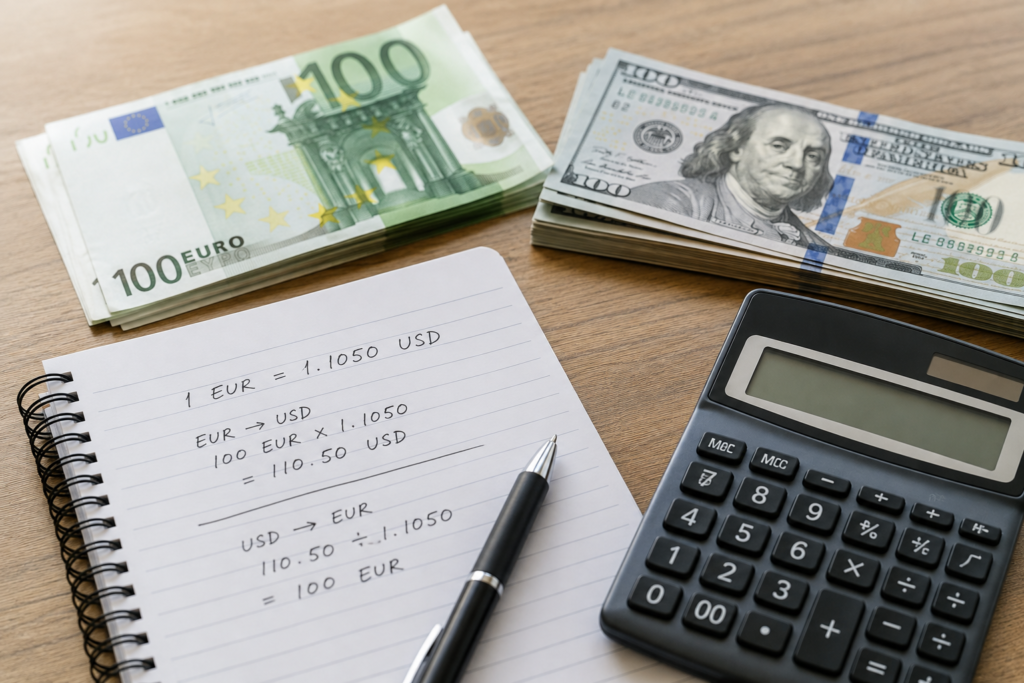
How to Read an Exchange Rate Step by Step
Let’s use a hypothetical exchange rate:
EUR/USD = 1.20
Here’s how to read it.
Step 1: Look at the First Currency
EUR comes first, so the euro is the base currency.
Step 2: Look at the Second Currency
USD comes second, so the U.S. dollar is the quote currency.
Step 3: Read the Exchange Rate
The rate is 1.20.
Therefore:
€1 = $1.20
If you wanted to convert €100 at that rate before considering any fees or provider markup:
€100 × 1.20 = $120
So €100 would theoretically equal $120 at that exchange rate.
For a deeper explanation of performing these calculations yourself, see our guide to How to Calculate Currency Conversion Manually Using an Exchange Rate.
What Does USD/EUR Mean?
The order of a currency pair matters.
Consider these two pairs:
EUR/USD
and
USD/EUR
They compare the same two currencies, but they are not read the same way.
If:
EUR/USD = 1.20
that means one euro equals $1.20.
The inverse quote would be approximately:
USD/EUR = 0.8333
That means one U.S. dollar equals approximately €0.83.
You can calculate an inverse exchange rate using:
Inverse rate = 1 ÷ exchange rate
Using our example:
1 ÷ 1.20 = 0.8333
This is one reason you should always pay attention to the order in which currencies are displayed.
How Are FX Rates Quoted?
In foreign exchange, or FX, currencies are generally quoted as pairs because exchanging money always involves comparing one currency with another.
Common currency pairs include:
- EUR/USD — euro and U.S. dollar
- GBP/USD — British pound and U.S. dollar
- USD/JPY — U.S. dollar and Japanese yen
- USD/CAD — U.S. dollar and Canadian dollar
- AUD/USD — Australian dollar and U.S. dollar
The letters are standardized three-letter currency codes.
For example:
- USD = U.S. dollar
- EUR = euro
- GBP = British pound sterling
- JPY = Japanese yen
- CAD = Canadian dollar
- AUD = Australian dollar
Once you recognize the currency codes, exchange-rate quotes become much easier to interpret.
What Is a Direct Exchange Rate Quote?
A direct quote expresses the value of a foreign currency in terms of the observer’s domestic currency.
What counts as “direct” therefore depends on your perspective.
For example, imagine someone in the United States sees:
EUR/USD = 1.17
The quote indicates how many U.S. dollars are required for one euro.
For someone treating USD as the domestic currency, this can be viewed as a direct quotation of the euro’s price in dollars.
The important thing for everyday consumers isn’t memorizing terminology. It’s understanding what the quote actually tells you.
Ask yourself:
How much of the second currency does one unit of the first currency represent?
That question will help you interpret most standard currency pairs.
What Is an Indirect Exchange Rate Quote?
An indirect quote reverses the perspective.
Instead of showing how much domestic currency corresponds to one unit of foreign currency, it shows how much foreign currency corresponds to one unit of domestic currency.
Using a simplified example:
If:
EUR/USD = 1.20
then the inverse is approximately:
USD/EUR = 0.8333
These are two ways of expressing the relationship between the same currencies.
This is also why simply comparing the numbers in two exchange-rate displays can sometimes be confusing. You need to make sure the currencies are listed in the same order.
Why Do Some Exchange Rates Look Very Different?
You might see one currency pair quoted at 1.15 while another is quoted at 150 or more.
That doesn’t necessarily mean one currency is “150 times better” than another.
The number depends on the currencies being compared and how the pair is quoted.
For example, a USD/JPY quote will naturally look very different from an EUR/USD quote because the currencies have different unit values.
Instead of focusing on whether the exchange-rate number looks large or small, focus on what one unit of the base currency buys in the quote currency.
What Are Buy and Sell Exchange Rates?
Currency-exchange providers may display more than one exchange rate.
You might see terms such as:
Buy rate
and
Sell rate
These rates can be different because businesses exchanging currencies need to cover their costs and may build a margin into the rates they offer.
From the provider’s perspective, the buy rate is generally the rate at which it buys a currency, while the sell rate is the rate at which it sells that currency.
That distinction matters because the rate displayed prominently online or in financial markets may not be the exact rate you receive when physically exchanging money.
Why Is There a Difference Between Buy and Sell Rates?
The difference between the buying and selling prices is commonly associated with the exchange-rate spread.
Suppose a provider is willing to buy a currency at one rate but sell it at a slightly different rate.
That gap can help compensate the provider for operating costs, market risk, and profit.
This is why two people exchanging the same currencies in opposite directions may not simply receive perfectly inverse amounts.
You can learn more in our guide to Exchange Rate Spread Explained.
Market Exchange Rate vs. Customer Exchange Rate
Another important distinction is the difference between a market exchange rate and the rate offered to an individual customer.
You might look up an exchange rate online and see one number, then visit a bank or exchange provider and receive another.
That doesn’t necessarily mean the online rate is wrong.
Different rates may be involved.
Market or Mid-Market Rate
The mid-market rate is generally the midpoint between market buy and sell prices.
It can serve as a useful reference when comparing currency-conversion offers.
Customer Rate
A bank, card network, ATM operator, money-transfer service, or currency-exchange company may offer customers a different rate.
That rate can incorporate a markup or spread.
There may also be separate transaction or service fees.
For more information, read Currency Mid-Market Rate Explained.
Example: Reading an Exchange Rate While Traveling
Imagine you’re traveling from the United States to Europe.
You see:
EUR/USD = 1.18
That tells you:
€1 = $1.18
If something costs €50, a rough conversion would be:
50 × 1.18 = $59
So €50 is approximately $59 at that hypothetical rate before any card fees, currency-conversion charges, or exchange-rate markup.
Understanding the currency pair helps you quickly estimate what foreign prices mean in your home currency.
Example: Reading an Exchange Rate in Reverse
Now suppose you have $100 and want to estimate its value in euros.
If:
EUR/USD = 1.18
you should not multiply $100 by 1.18 because the quotation is showing dollars per euro.
Instead, divide:
$100 ÷ 1.18 = approximately €84.75
This is where many currency-conversion mistakes happen.
Whether you multiply or divide depends on the direction of the conversion and how the exchange rate is quoted.
Our guide to How to Convert Money From One Currency to Another explains this process in more detail.
Why Currency-Pair Order Matters
Currency-pair order isn’t just a formatting detail.
It determines how you interpret the exchange rate.
If you see:
USD/CAD = 1.36
that means:
$1 USD = $1.36 CAD
But if you see:
CAD/USD
you’re looking at the relationship from the opposite direction.
Before doing any currency calculation, check:
- Which currency is listed first?
- Which currency is listed second?
- Which currency do you currently have?
- Which currency do you want to receive?
Answering these questions can help you determine whether you should multiply, divide, or use the inverse rate.
How to Compare Exchange Rates From Different Providers
If you’re comparing rates from banks, airport exchange counters, ATMs, card issuers, or money-transfer services, don’t compare only the headline exchange-rate number.
First make sure each provider is quoting the currencies in the same direction.
Then consider:
- The exchange rate being offered
- Any exchange-rate markup or spread
- Transfer or transaction fees
- ATM fees
- Foreign transaction fees
- The final amount of currency you actually receive
The provider advertising the most attractive-looking rate isn’t necessarily the cheapest once all charges are included.
A useful comparison is often:
How much of the destination currency will I actually receive after the entire transaction?
Why Exchange Rates Change
Exchange rates don’t remain fixed for most major currencies.
Their values can move as buyers and sellers participate in global currency markets.
Factors that can influence exchange rates include:
- Interest rates
- Inflation expectations
- Central-bank decisions
- Economic growth
- Employment data
- International trade
- Political and economic uncertainty
- Supply and demand for currencies
Because exchange rates fluctuate, a currency quote you see today may be different tomorrow.
That is why examples in educational articles should be treated as illustrations rather than current market quotations.
Common Mistakes When Reading Exchange Rates
Confusing the Base and Quote Currencies
Always remember:
First currency = base currency
Second currency = quote currency
Assuming You Always Multiply
Sometimes multiplication is correct. Other times you need to divide.
It depends on the direction of the conversion and how the rate is quoted.
Assuming the Online Rate Is the Rate You’ll Receive
A market rate is useful as a benchmark, but banks and other providers can offer a different customer exchange rate.
Ignoring Fees
Even a competitive exchange rate can become more expensive when transaction fees or other charges are added.
Comparing Reversed Currency Pairs
EUR/USD and USD/EUR describe the same currency relationship from opposite directions.
Always make sure you’re comparing rates written in the same order.
Frequently Asked Questions
What does an exchange rate of 1.20 mean?
It depends on the currency pair.
If EUR/USD is 1.20, it means one euro corresponds to 1.20 U.S. dollars.
The exchange-rate number cannot be interpreted correctly without knowing the currencies and their order.
Which currency comes first in an exchange rate?
The first currency is called the base currency.
In EUR/USD, EUR is the base currency.
What is the second currency called?
The second currency is called the quote currency or counter currency.
In EUR/USD, USD is the quote currency.
How do you read USD/JPY?
USD is the base currency and JPY is the quote currency.
If USD/JPY were 150, for example, that would mean one U.S. dollar corresponds to 150 Japanese yen.
How do you reverse an exchange rate?
Divide 1 by the original exchange rate.
For example:
1 ÷ 1.20 = 0.8333
Therefore, if one direction is quoted at 1.20, the mathematical inverse is approximately 0.8333.
Why does my bank show a different exchange rate than Google or a currency converter?
Banks and other currency providers may include a spread or markup in the customer rate. Separate fees can also apply. A converter may instead show a market-based reference rate.
Are buy and sell exchange rates the same?
Usually not. Currency providers can quote different rates for buying and selling a currency. The difference between those prices contributes to the exchange-rate spread.
The Bottom Line
Exchange rates become much easier to understand once you know how currency pairs work.
Remember the basic rule:
The first currency is the base currency, the second is the quote currency, and the exchange rate tells you how much of the quote currency corresponds to one unit of the base currency.
So if:
EUR/USD = 1.20
you can read it as:
€1 = $1.20
Before exchanging money, also remember that the market rate you see online may not be the final rate offered by your bank, card issuer, ATM, or currency-exchange provider.
Understanding the quote—and then checking the spread and fees—can help you make a much more informed currency-conversion decision.
VoltCurrency provides educational information about currencies, exchange rates, and currency conversion. Exchange rates fluctuate and may vary by bank, card issuer, ATM, payment processor, or money-transfer provider. Examples in this article are hypothetical and are not live exchange-rate quotes. Always confirm the current rate, fees, and final amount with your financial provider before completing a transaction.