
Learn how to calculate currency conversion manually using a simple exchange rate formula, including when to multiply or divide, with easy examples.
You don’t always need a currency converter to figure out how much your money is worth in another currency.
Once you understand the basic currency conversion formula, you can calculate an exchange yourself with a calculator—or even on paper.
The basic idea is simple:
Amount of money × exchange rate = converted amount
However, there is one catch: sometimes you need to multiply, while other times you need to divide. It depends on how the exchange rate is written.
This guide explains how to calculate currency conversion manually, how to know whether to multiply or divide, and how to avoid some of the most common mistakes.
Quick Answer: What Is the Currency Conversion Formula?
The most common currency conversion formula is:
Amount in original currency × exchange rate = amount in new currency
For example, imagine the USD-to-EUR exchange rate is:
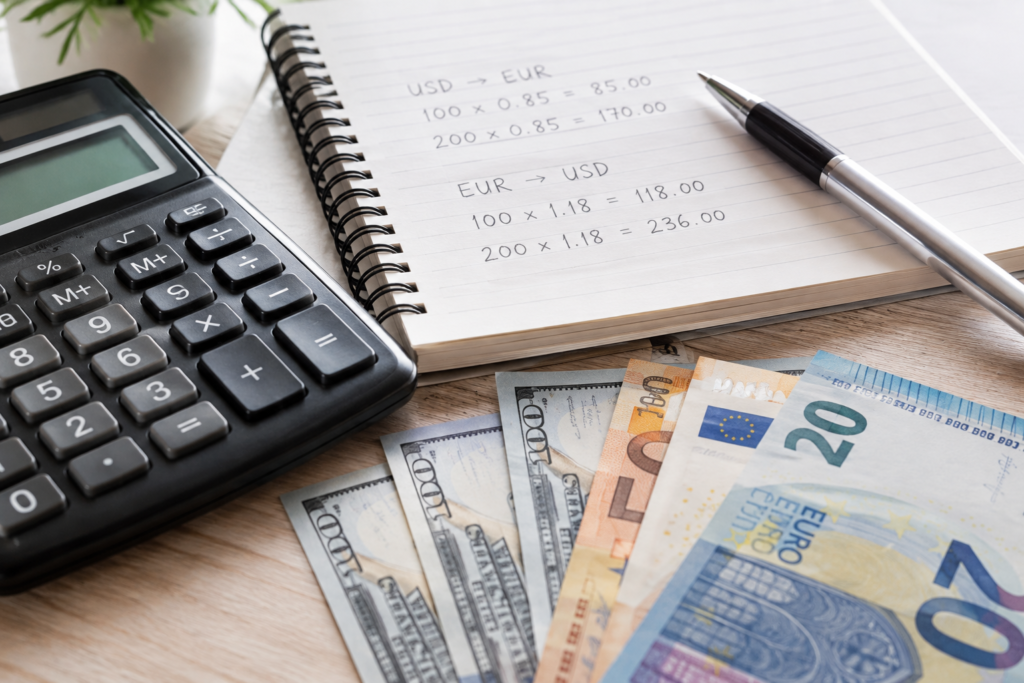
1 USD = 0.85 EUR
If you want to convert $200:
200 × 0.85 = 170
Your estimated converted amount would therefore be:
€170
Keep in mind that this is a mathematical example. Actual exchange rates constantly change, and banks, card issuers, ATMs, and currency-exchange services may add fees or use a different customer rate.
Before You Calculate: Check How the Exchange Rate Is Written
Before multiplying or dividing, look carefully at the direction of the exchange rate.
For example:
1 USD = 0.85 EUR
This tells you how many euros correspond to one U.S. dollar at that example rate.
If you are converting USD to EUR, the rate is already written in the direction you need, so you can multiply:
USD amount × 0.85 = estimated EUR amount
If you want to convert in the opposite direction—from EUR back to USD—you need the inverse relationship. You can either divide by 0.85 or calculate the reciprocal of the rate.
This is why understanding how an exchange rate is written is just as important as knowing the conversion formula itself.
Try the VoltCurrency Converter
Want to check your manual calculation?
Use the currency converter below to compare currencies quickly.
Currency Converter
The converter is especially useful after doing the calculation yourself because it gives you an easy way to check whether your math is in the right range.
How Currency Conversion Works
An exchange rate tells you how much one currency is worth when measured in another currency.
Suppose you see:
1 USD = 0.85 EUR
That means one U.S. dollar is worth 0.85 euros at that particular rate.
If you have multiple dollars, you simply multiply the number of dollars by 0.85.
For $50:
50 × 0.85 = €42.50
For $100:
100 × 0.85 = €85
For $500:
500 × 0.85 = €425
The same basic calculation works with other currency pairs.
Step 1: Identify the Currency You Have
Before doing any calculation, identify your starting currency.
For example, perhaps you have:
$750 USD
and want to know approximately how many euros that amount represents.
USD is your starting currency, sometimes called the base currency in a quoted currency pair.
EUR is the currency you want to receive.
Knowing the direction matters because reversing the currencies changes the rate you need.
Step 2: Find the Exchange Rate
Next, you need the exchange rate between the two currencies.
For our example, we’ll use a hypothetical rate of:
1 USD = 0.85 EUR
Exchange rates fluctuate, so always use a current rate when calculating an actual transaction.
Also remember that the rate you see quoted online may be a mid-market or reference rate rather than the exact rate your bank, credit card, ATM, or money-transfer provider gives you.
Step 3: Multiply the Amount by the Exchange Rate
Now apply the formula:
Starting amount × exchange rate = converted amount
Using our example:
$750 × 0.85 = €637.50
At that hypothetical exchange rate, $750 would therefore equal approximately €637.50 before any fees or exchange-rate markup.
That’s the basic currency conversion calculation.
Another Currency Conversion Example
Suppose you want to convert 300 U.S. dollars into Canadian dollars.
For this example, imagine:
1 USD = 1.37 CAD
Calculate:
300 × 1.37 = 411
The result would be:
300 USD = approximately 411 CAD
Again, the rate is only an example. Use the current exchange rate when making a real calculation.
When Do You Divide Instead of Multiply?
This is where currency conversion sometimes becomes confusing.
Imagine you’re given:
1 USD = 0.85 EUR
but you have euros and want to determine their approximate value in dollars.
You cannot simply use the same multiplication calculation in the opposite direction.
Instead, you can calculate the inverse rate.
The formula is:
1 ÷ exchange rate = inverse exchange rate
Using our example:
1 ÷ 0.85 ≈ 1.1765
That means:
1 EUR ≈ 1.1765 USD
If you had €500:
500 × 1.1765 ≈ $588.25
Another way of expressing the same calculation is:
500 ÷ 0.85 ≈ $588.24
Small differences can occur because of rounding.
Easy Rule to Remember
If the exchange rate is already written in the direction you need, you will generally multiply.
If you are reversing the quoted rate, you may need to divide or calculate the reciprocal first.
Always pay attention to which currency is on each side of the exchange rate.
How to Calculate an Exchange Rate Between Two Currencies
Sometimes you already know both amounts and want to determine the exchange rate itself.
For example:
Suppose:
$400 USD = €340 EUR
To calculate the EUR-per-USD exchange rate:
340 ÷ 400 = 0.85
Therefore:
1 USD = 0.85 EUR
The formula is:
Converted amount ÷ original amount = exchange rate
This can be useful when reviewing receipts, bank transactions, card purchases, or currency-exchange transactions.
Why Your Bank’s Conversion May Be Different
You may calculate a conversion perfectly and still see a different amount on your bank or credit-card statement.
That doesn’t necessarily mean your calculation was wrong.
There can be a difference between the market exchange rate and the rate actually offered to customers.
A provider may include:
- An exchange-rate markup
- A currency conversion fee
- A foreign transaction fee
- An ATM fee
- A transfer fee
- Other service charges
This is why it is useful to understand the difference between the quoted exchange rate and the amount you ultimately receive or pay.
What Is the Exchange Rate Spread?
The exchange rate spread is the difference between rates associated with buying and selling currencies, or between a reference rate and the rate offered to a customer.
For consumers, the important point is that the rate available in an actual transaction may not match the rate you saw when researching the currency.
Even a relatively small difference can become more noticeable when converting larger amounts.
Understanding the spread can therefore help you compare currency-conversion options more carefully.
Example: Calculating the Cost of a Currency Conversion
Imagine you want to convert $1,000 into another currency.
The reference rate you find is:
1 USD = 0.85 units of the destination currency
At that rate:
1,000 × 0.85 = 850
But suppose the provider gives you a customer rate of:
1 USD = 0.82
Your actual conversion would be:
1,000 × 0.82 = 820
The difference is:
850 − 820 = 30
This example shows why looking only at the headline exchange rate doesn’t always tell you what a currency conversion will actually cost.
How to Calculate Currency Conversion With a Calculator
You don’t need a special financial calculator.
Open the calculator on your phone or computer and enter:
Amount × exchange rate
For example:
250 × 0.85
Result:
212.50
That’s it.
For a reversed calculation, you can enter:
250 ÷ 0.85
Result:
approximately 294.12
Just make sure you understand which direction you’re converting before choosing multiplication or division.
How to Check Whether Your Currency Conversion Makes Sense
A quick estimation can help you catch mistakes.
Suppose:
1 USD = 0.85 EUR
Because 0.85 is less than 1, you know that multiplying a dollar amount by 0.85 should produce a smaller numerical amount.
Therefore:
$100 → approximately €85
makes mathematical sense using that rate.
But if your calculator suddenly tells you:
$100 → €8,500
you immediately know something went wrong.
Simple estimates are surprisingly useful for spotting misplaced decimals and reversed exchange rates.
Common Currency Conversion Mistakes
Using an Outdated Exchange Rate
Currency values fluctuate. A rate you saved weeks or months ago may no longer reflect the current market.
Reversing the Currency Pair
USD/EUR and EUR/USD represent opposite directions.
Always check which currency you’re starting with.
Multiplying When You Should Divide
This frequently happens when someone is given a rate in the opposite direction from the conversion they want to perform.
Ignoring Fees
The mathematical conversion isn’t necessarily the amount you’ll actually receive.
Assuming Every Provider Uses the Same Rate
Banks, payment processors, ATMs, card issuers, and money-transfer services can use different customer rates and fee structures.
Rounding Too Early
If you’re doing several calculations, keep additional decimal places until the final step. Rounding too early can slightly change your result.
Manual Currency Conversion vs. Currency Converter
Manual calculation is valuable because it helps you understand what’s happening behind the number.
A currency converter is more convenient when you want a quick estimate.
Using both can be even better.
You can calculate:
Amount × exchange rate
and then compare your result with a converter.
If the numbers are substantially different, investigate whether you’re using a different rate, reversed currency pair, outdated exchange rate, or additional fees.
Why Learning the Formula Is Useful
Knowing how currency conversion works can be helpful when:
- Traveling internationally
- Comparing hotel prices
- Shopping on international websites
- Reviewing foreign credit-card purchases
- Sending money internationally
- Receiving payments in another currency
- Comparing exchange services
- Creating an international travel budget
Instead of simply trusting a number on a screen, you’ll understand how that number was calculated.
Frequently Asked Questions
What is the formula for currency conversion?
When the exchange rate is quoted in the direction you need, the basic formula is:
Original amount × exchange rate = converted amount
How do I manually convert currency?
Find the appropriate exchange rate, identify the direction of the conversion, and multiply your starting amount by the rate. If the rate is quoted in the opposite direction, you may need to calculate its inverse or divide instead.
How do you calculate an exchange rate?
If you know the original and converted amounts, divide the converted amount by the original amount.
For example:
340 ÷ 400 = 0.85
So if $400 converts to €340, the corresponding rate is 0.85 EUR per USD.
Do I multiply or divide for currency conversion?
Usually, multiply when the quoted exchange rate matches the direction of your conversion. If you’re reversing that quoted relationship, divide by the original rate or use its reciprocal.
Why is my currency conversion different from Google or my bank?
The sources may be using different exchange rates or timestamps. A bank, card issuer, ATM, or payment service may also apply a markup or fee.
Are currency conversion rates always the same?
No. Exchange rates fluctuate, and the customer rates offered by financial institutions can differ from market reference rates.
Final Thoughts
Learning how to calculate currency conversion manually is much easier once you understand the basic formula:
Amount × exchange rate = converted amount
The most important part isn’t the multiplication itself. It’s making sure you’re using the correct exchange rate in the correct direction.
Once you understand that distinction, you can manually estimate conversions, check calculator results, compare rates, and better understand what happens when money moves from one currency to another.
For current calculations, use an up-to-date exchange rate and remember that the final amount from a bank, card issuer, ATM, or money-transfer service may differ because of fees or rate markups.
VoltCurrency provides currency and financial information for educational purposes only. Exchange rates fluctuate and rates shown in examples may not reflect current market rates or the rates offered by financial institutions. Always verify current rates, fees, and transaction terms with your financial provider before making financial decisions.